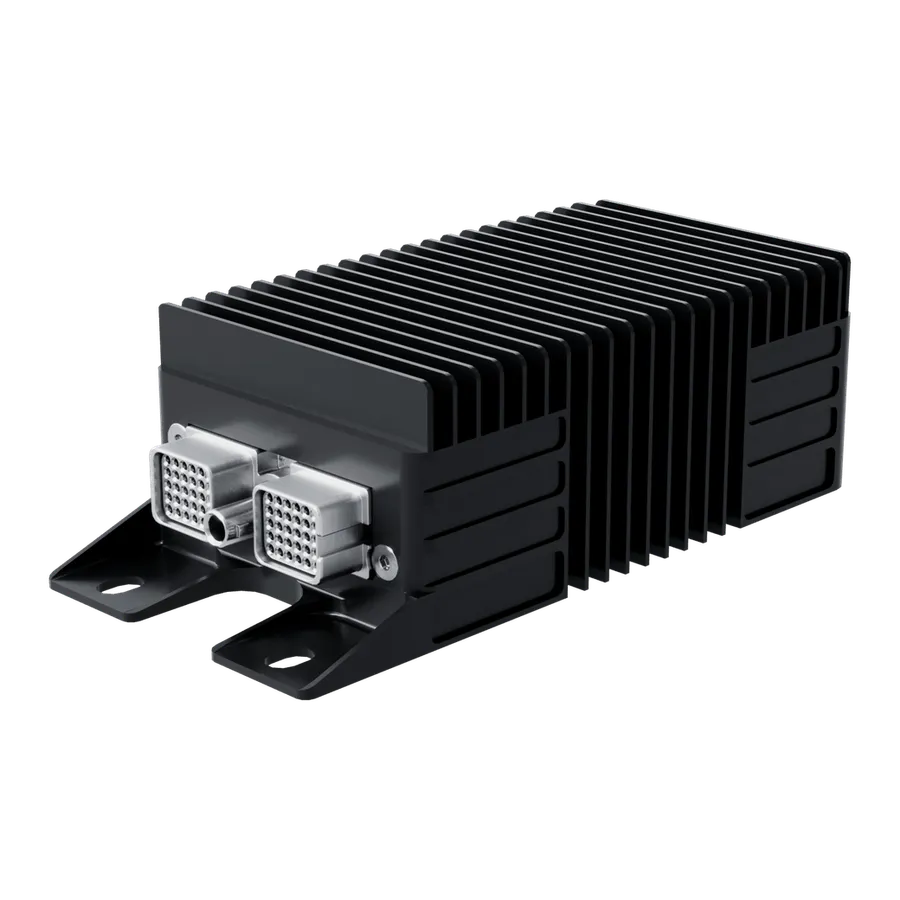
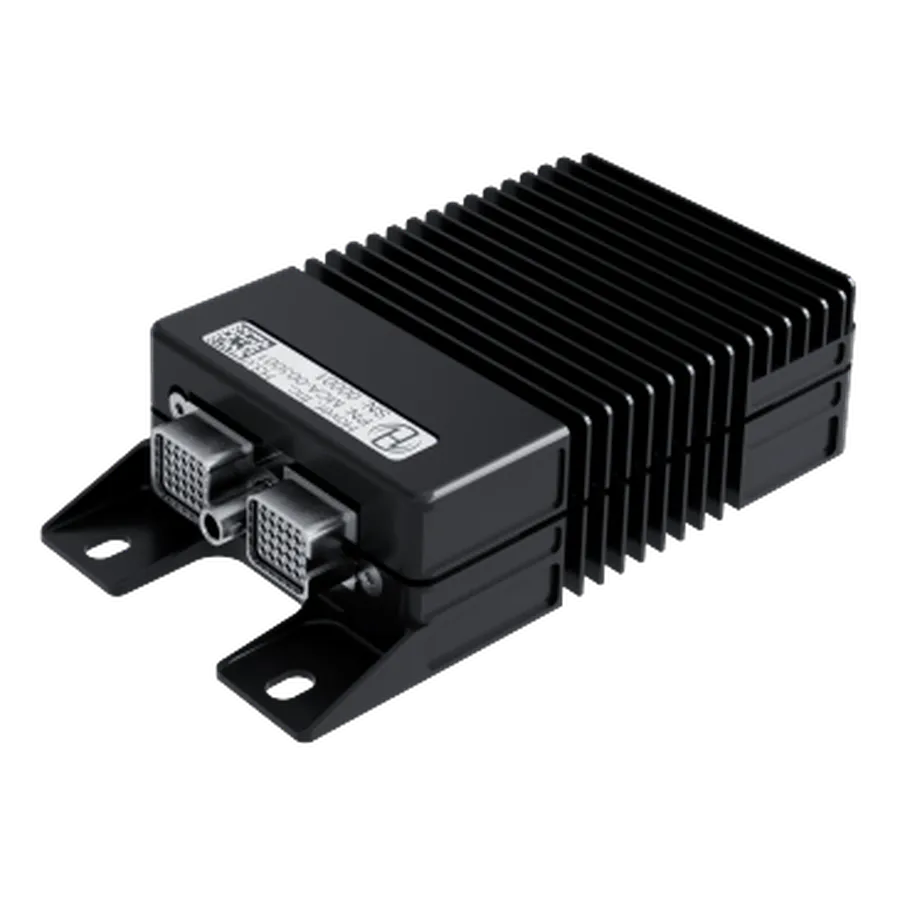
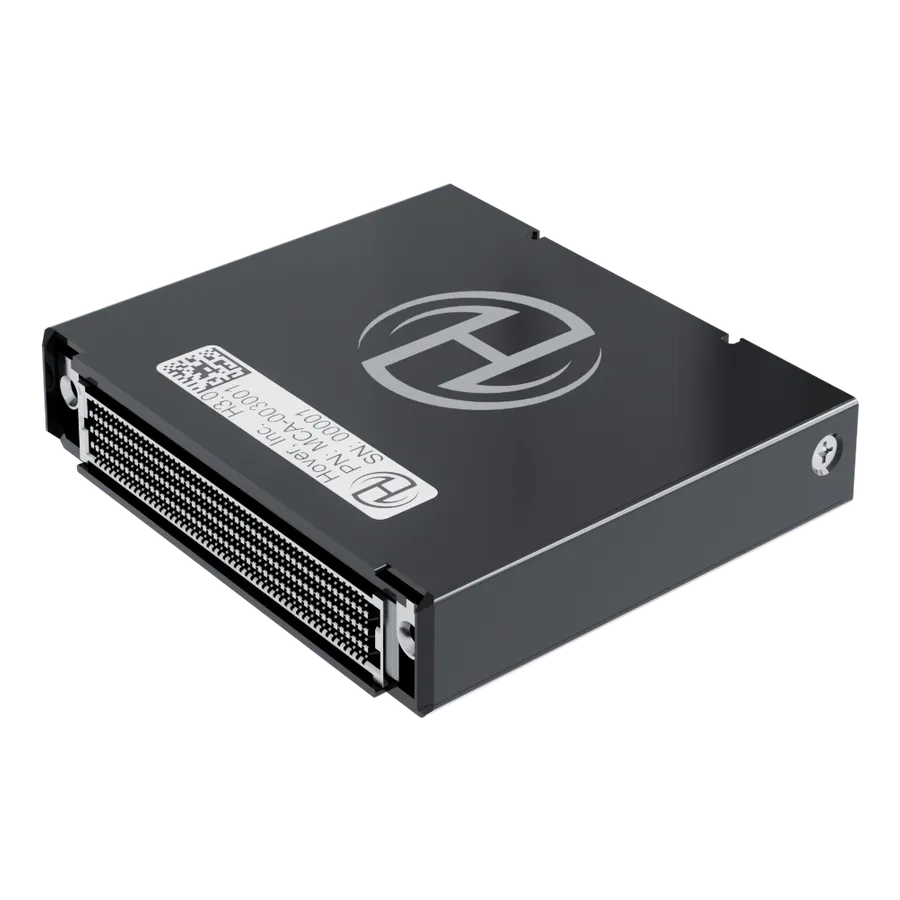
H1.X Computer
For applications that require redundancy
- Architecture
- Dual channel
- Mass
- 650 g
- Power
- 20 W maximum
- Isolation
- Galvanically isolated
Typical applications
- Cockpit display computer
- Flight computer
- Powertrain and motor controller

Low Size, Weight, and Power (SWaP) computers for next-generation aircraft. Each computer delivers unrivaled performance and ruggedization for the harshest operating environments.
The H-series comprises Integrated Modular Avionics (IMA) platforms and an IMA module authorized under TSO-C153a, with software developed to DO-178C and hardware to DO-254 at Development Assurance Level (DAL) A, environmental qualification to DO-160G, and the DO-297 data required to integrate them.
For applications that require redundancy
Typical applications
For applications that do not require redundancy
Typical applications
For data concentrator and battery or fuel cell management applications
Typical applications
For Modular Open Systems Approach (MOSA) flight and mission computing applications
Typical applications
Every H-series computer ships with the Hover Real-Time Operating System (H-RTOS), Hover Software Development Kit (H-SDK), and Hover Data Loader (H-DL). Hardware, software, and tools share a single TSO-C153a baseline, so you have no integration gap to close and no separate baseline to maintain.
ARINC 653P1-6 partitioned real-time operating system
Software applications of different criticality share one multi-core 64-bit Arm IMA platform.
Explore the ARINC 653 RTOSExplore the ARINC 653 RTOS: H-RTOSBuild, configure, validate, and verify
Configure, debug, and verify software applications in VS Code, in an emulator or on the target.
Explore the software development kitExplore the software development kit: H-SDKARINC 615A-4 data loader
Gigabit ARINC 615A loading, in the lab, in production, or on the aircraft.
Explore the ARINC 615A data loaderExplore the ARINC 615A data loader: H-DLThe H-series family of computers covers simplex through quadruplex architectures on transport aircraft, rotorcraft, electric Vertical Takeoff and Landing (eVTOL) and Advanced Air Mobility (AAM) aircraft, and uncrewed aircraft. We support manufacturers from safety analysis through certification, with Federal Aviation Administration (FAA) Designated Engineering Representatives (DERs) on staff.
Retrofit and new designs, including more-electric transport-category aircraft
eVTOL aircraft with electric or hybrid-electric powertrains
Attritable Uncrewed Aircraft Systems (UAS) and loyal wingman
IMA computers from incumbent Tier 1 suppliers offer limited flexibility. You are often forced to work with separate hardware, software, and tool vendors and manage the integration challenges between them. We supply a comprehensive hardware, software, and tool ecosystem with no hidden costs, so you can focus on developing your software applications.
Hover
Open, standards-based system
Aligned with the Future Airborne Capability Environment (FACE) and PYRAMID, so software applications port seamlessly between IMA platforms.
Incumbent Tier 1
Closed, hardcoded system
Proprietary interfaces lock your software applications to a specific vendor, and you are forced to pay them for maintenance and additional features.
Hover
Own the IP
You own the software applications and associated Intellectual Property (IP).
Incumbent Tier 1
Share the IP with the vendor
You share the IP with the vendor, who is free to compete with you.
Hover
Single purchase
You receive an IMA platform authorized under TSO-C153a, with its software and qualified tools, as one comprehensive ecosystem. You integrate only your software applications, using the H-SDK.
Incumbent Tier 1
Multiple purchases
You buy hardware, software, and qualified tools from different vendors and you integrate them and take them through the certification process.
Hover
Control over testing
You execute and debug software applications on the target using a VS Code-based debugger.
Incumbent Tier 1
Opaque testing
Integration, prototyping, and verification and validation testing depend on the vendor.
We offer an edge inference main processing board that enables airborne Artificial Intelligence (AI) and autonomy on next-generation aircraft. It is compatible with every H-series computer and executes machine learning models deterministically.
The first known int8 neural processing unit that is capable of executing Convolutional Neural Networks (CNNs) and Vision Transformers (ViTs) on the edge. Fully deterministic, with no data-dependent branches, no caches, and no variable-latency math. It tracks at 60 fps while executing detection at about 5.5 Hz.
With DALs assigned under ARP4761A, the edge inference main processing board is developed to DAL C and the safety-critical main processing board to DAL A. Pairing the two boards addresses regulatory dissimilarity requirements and supports DAL A at the equipment level.
The Altera Agilex 5 was selected over Field-Programmable Gate Arrays (FPGAs) from AMD and Microchip because of its performance per watt and tensor/Digital Signal Processing (DSP) block architecture. It combines big.LITTLE hard processor cores and programmable fabric on a single device.
We are avionics, hardware, software, firmware, and machine learning engineers in Cambridge, UK, and Seattle, US, building computers and edge systems for the next generation of aircraft.
Watch our film from the Farnborough International Airshow 2026 to see the H-series and the people behind it.
Contact our aerospace engineering and certification teams to discuss your system architecture, SWaP optimization requirements, and FAA or European Union Aviation Safety Agency (EASA) certification pathway.
Describe your program requirements, and our engineering team will respond with a tailored SWaP and redundancy assessment.